3D generation is making simulated scenes cheap to produce, which shifts the advantage toward the measured physical properties and consistent labels that those scenes cannot invent.
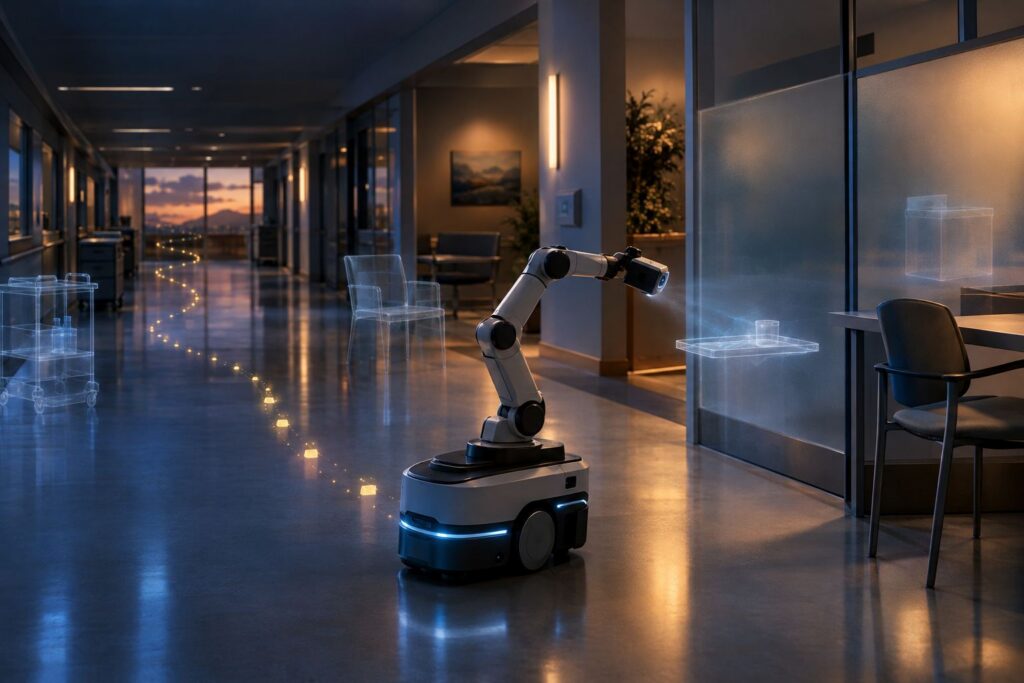
Furnishing a simulator used to be craft work. If you wanted a robot to practice in a kitchen, someone modeled the kitchen, from the cabinets and handles down to the clutter on the counter, and each object was built and positioned by hand. Generative tools have started taking over that job, and a recent survey titled 3D Generation for Embodied AI and Robotic Simulation pulls the scattered research in the area into a single map of what is being built and how the pieces relate.
The authors report no headline number, because the contribution is the map itself: an organized account of how 3D generation methods are being applied to the scenes, objects and assets that embodied AI and robotic simulation run on. For anyone building or backing robots, a map like that is most useful as a warning, since the methods have multiplied faster than any agreement about them and the work of reconciling them lands on whoever is assembling the training corpus.
The Properties A Picture Cannot Carry
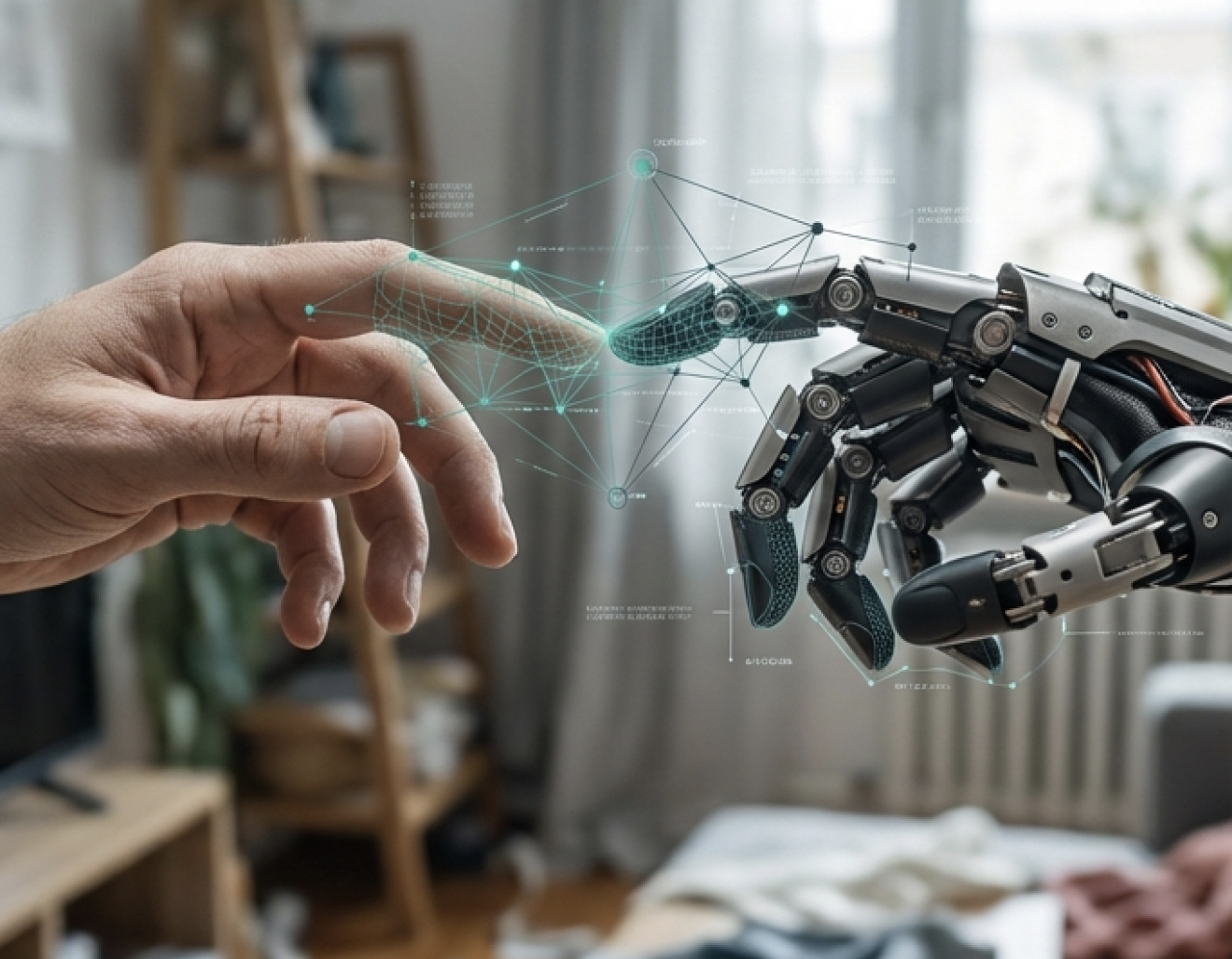
A generated mug can look perfect and still be useless for training. What decides whether a robot lifts it is mass, friction, where the center of gravity sits, and how much force the handle takes before it slips, and none of that lives in the surface of an image. The same holds for anything that moves. A drawer, a fridge door and a latch each have limits, resistances and failure modes, and a model that produces convincing geometry is not thereby producing those quantities.
I find this the quiet constraint underneath most conversations about synthetic worlds. Appearance is the part of the problem that looks hard and has been yielding fastest, while the physical attributes of an object are the part that looks dull and still has to be measured by someone holding the object. To me that is the whole difference between a scene that renders and a scene a policy can act in.
Nothing Has Converged On A Single Format
Generation methods do not agree on what they produce. Some output meshes, some output point clouds, some output neural representations that have to be converted before a physics engine will accept them. The semantics vary just as much: one asset arrives with named, separable parts, another arrives as a single undifferentiated shell with a handle painted on it.
For a team assembling a training corpus, that is a running cost rather than a one-time conversion. Every new generator brings another conversion path, another vocabulary of labels to normalize, and another round of checking that the thing labeled a drawer actually slides when something pulls it.
What turns a heterogeneous pile of assets into a usable corpus is annotation discipline: consistent labels across 3D geometry, sensor data and video, applied by trained people working to one standard. Our subsidiary Flipside AI provides data curation, annotation and validation services for AI systems, including 3D annotation and LiDAR and sensor fusion annotation.1 We develop and deliver embodied intelligence services through vertically integrated infrastructure spanning high-quality data collection, supervised annotation, and AI training data delivery.2
Where I Would Put The Engineering Effort
What I would watch is whether generated assets begin arriving with physical attributes attached and with a shared way of describing parts, joints and affordances, or whether the field keeps producing better looking rooms that every team has to re-measure and re-label on its own. I think the second outcome is the default until someone is paid to do the first, because describing an object precisely is slow, unglamorous work and rendering it beautifully is not. The groups that gain most from cheap generation are the ones who already know how to describe an object rigorously, since generation hands them more surface to describe rather than less.
Generation has made the look of a world cheap. It has not made the behavior of a world cheap, and behavior is what a robot is actually learning when it practices. The scarce thing in embodied intelligence is not scenes. It is the grounded, carefully described record of how real objects move, resist and fail, and I think that record is where the advantage in this field sits.
Sources
- NOTE 1, ORGANIZATION AND DESCRIPTION OF BUSINESS, 10-Q, filed 2026-08-14
- (exhibit EX-99.2: PRESS RELEASE), 8-K, filed 2026-08-17
Disclosure
The following cautionary statement is reproduced from a Quarterly Report on Form 10-Q filed with the SEC.
Certain information included in this Quarterly Report on Form 10-Q and other filings of the Registrant under the Securities Act of 1933, as amended (the “Securities Act”), and the Securities Exchange Act of 1934, as amended (the “Exchange Act”), as well as information communicated orally or in writing between the dates of such filings, contains or may contain “forward-looking statements” within the meaning of Section 27A of the Securities Act and Section 21E of the Exchange Act. Forward-looking statements in this Quarterly Report on Form 10-Q, including without limitation, statements related to our plans, strategies, objectives, expectations, intentions and adequacy of resources, are made pursuant to the safe harbor provisions of the Private Securities Litigation Reform Act of 1995. Such statements are subject to certain risks, trends and uncertainties that could cause actual results to differ materially from expected results. Among these risks, trends and uncertainties are the availability of working capital to fund our operations, the competitive market in which we operate, the efficient and uninterrupted operation of our computer and communications systems, our ability to generate a profit and execute our business plan, the retention of key personnel, our ability to protect and defend our intellectual property, the effects of governmental regulation, and other risks identified in the Registrant’s filings with the Securities and Exchange Commission from time to time.