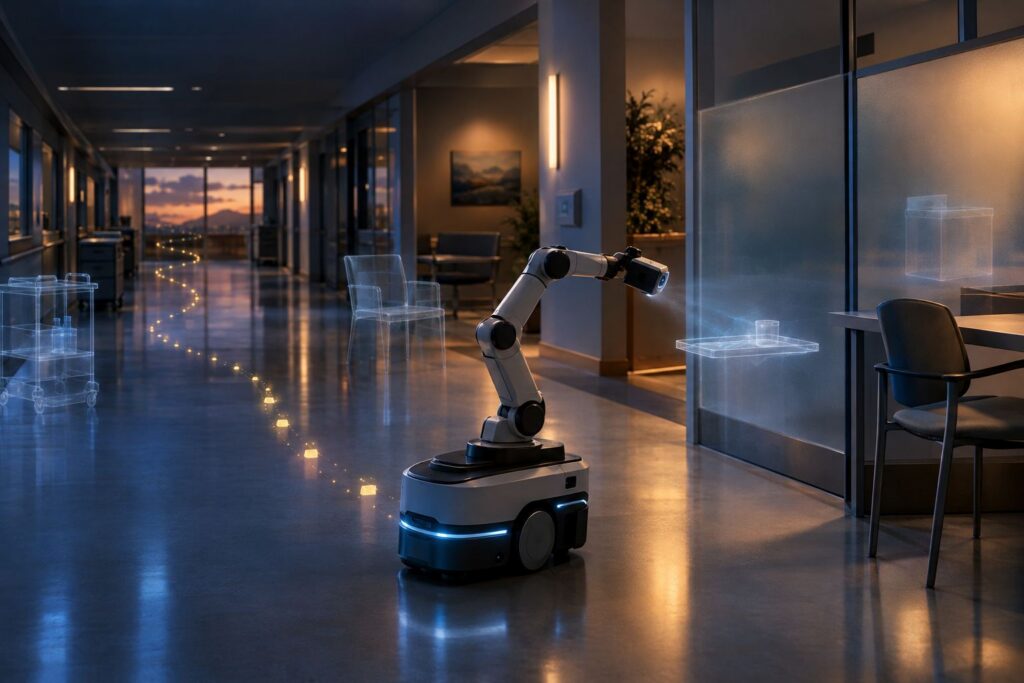
As coding agents mass-produce the simulated worlds robots train in, the scarce input becomes the measured reality that separates faithful worlds from plausible ones.
Robot teams have been sold the same promise for a decade. Train in simulation, where a machine can attempt a task a million times overnight, then carry the skill into a real building. The catch has never been compute. It is that the simulated worlds on hand cover a thin slice of the physical work people actually do, and each new one takes a specialist weeks to build. If that cost is the ceiling on the whole approach, anything that lifts it deserves a close read.
A Benchmark Built By Agents
A new preprint called Gym-Anything for Robotics goes at that cost directly. Its argument is that writing a simulation is, in the end, a coding job, so a coding agent can do it, and every improvement in coding agents shows up as richer and more faithful simulated worlds. The authors use United States output data to choose which kinds of physical work are worth simulating, write down what separates a good simulation and a good task from a bad one, then run an adversarial loop in which one agent builds and another audits the result against those definitions. What comes out is RoboWorld, a suite of simulated environments and training tasks graded by difficulty.
The headline finding is a failure. The authors report that even the best frontier models fail on every RoboWorld test task, averaging a reward of 0.06, which tells anyone building or backing robots that fluency in text and images does not convert into competence at moving objects. The paper then shows several ways to claw back performance, including repeated attempts with the model’s own history in context, a privileged teacher that reads the simulator’s hidden state and coaches a student, and code-written controllers that generate demonstrations across varied scenes to train vision-language-action models.
The Audit Is The Harder Half
I think the quiet move in that work is the selection rule. Picking what to simulate from where economic output actually sits is a tacit admission that the field has spent years simulating whatever was convenient, which is why so many impressive demos share a tabletop and a cube. I would watch the audit side far more closely than the generation side. An agent that writes a thousand environments is only valuable if something can say which of them behave like the world, and a check written by the same family of models that wrote the environments is a closed loop.
Opening that loop takes measurement. How much force it takes to seat a connector, how a cardboard box buckles when gripped at the wrong corner, how a wet surface changes a push: none of that falls out of an output table or a code review. It comes from instrumented capture of real objects and real people doing the work, recorded the same way every time and annotated so a machine can tell which part of the motion carried the task.
Demonstrations Inherit Their Source
The same dependency sits under generated demonstrations. A code policy can spray thousands of attempts across randomized scenes, and the model trained on them inherits whatever the generator assumed about where a human would grip, what order the steps go in and what counts as finished.
Those assumptions are only as good as the human reference behind them, and producing that reference at scale is a production problem before it is a research problem. It takes trained and managed teams, working under quality control to consistent standards, week after week. Through Flipside, our Philippines-based operating subsidiary, we now own that capacity rather than renting it.1 Across the field, that kind of capacity is the input that decides whether a generated world is a useful approximation or a confident fiction.
I find it clarifying that the cheaper simulations get to produce, the more the argument turns on grounding. When environments were scarce and handmade, the scarce thing was the environment. When agents can write them faster than anyone can read them, the scarce thing is the measured, carefully labeled record of physical work that lets you tell a faithful world from a plausible one. That record is where I would put the effort, and it is the part no agent can generate for itself.
Sources
- Flipside AI: A Transformational Acquisition, 8-K, filed 2026-08-17
Disclosure
The following cautionary statement is reproduced from a Quarterly Report on Form 10-Q filed with the SEC.
Certain information included in this Quarterly Report on Form 10-Q and other filings of the Registrant under the Securities Act of 1933, as amended (the “Securities Act”), and the Securities Exchange Act of 1934, as amended (the “Exchange Act”), as well as information communicated orally or in writing between the dates of such filings, contains or may contain “forward-looking statements” within the meaning of Section 27A of the Securities Act and Section 21E of the Exchange Act. Forward-looking statements in this Quarterly Report on Form 10-Q, including without limitation, statements related to our plans, strategies, objectives, expectations, intentions and adequacy of resources, are made pursuant to the safe harbor provisions of the Private Securities Litigation Reform Act of 1995. Such statements are subject to certain risks, trends and uncertainties that could cause actual results to differ materially from expected results. Among these risks, trends and uncertainties are the availability of working capital to fund our operations, the competitive market in which we operate, the efficient and uninterrupted operation of our computer and communications systems, our ability to generate a profit and execute our business plan, the retention of key personnel, our ability to protect and defend our intellectual property, the effects of governmental regulation, and other risks identified in the Registrant’s filings with the Securities and Exchange Commission from time to time.