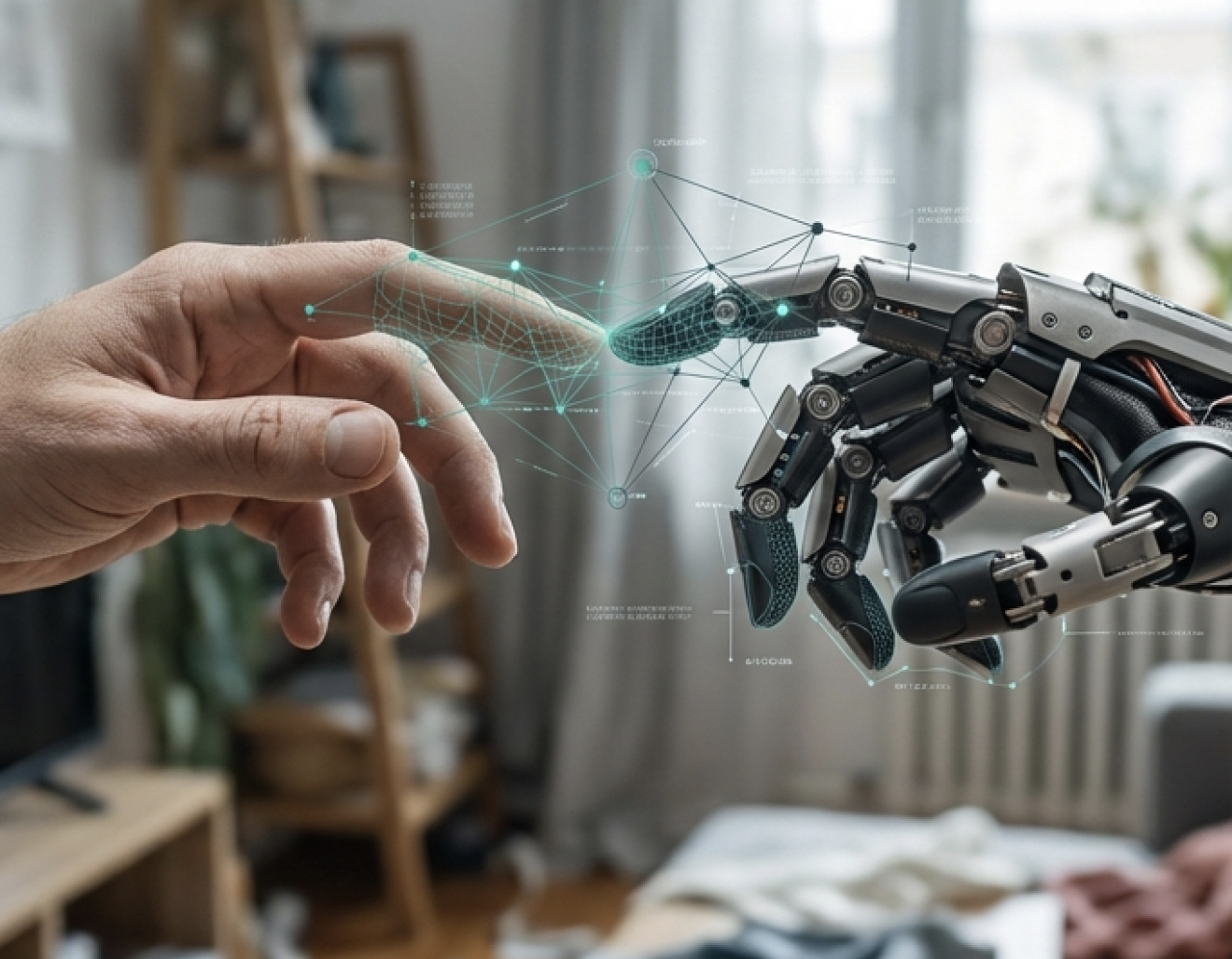
As robot policies start learning from their own mistakes as well as their successes, the scarce asset becomes a careful record of what went wrong and when.
A robot rarely fails all at once. It drifts. The gripper closes a fraction early, the object tips, and within a second or two the machine is in a situation that nothing in its training ever showed it, improvising badly in front of whoever paid for the demo.
That cascade is the practical reason so many impressive robot videos do not survive contact with a warehouse. Most robot policies today are trained by imitation: you show the system runs that worked and have it copy them. The runs that went wrong get deleted, which means the machine has never once been taught what the beginning of a mistake looks like.
Brittleness Comes From What The Data Left Out
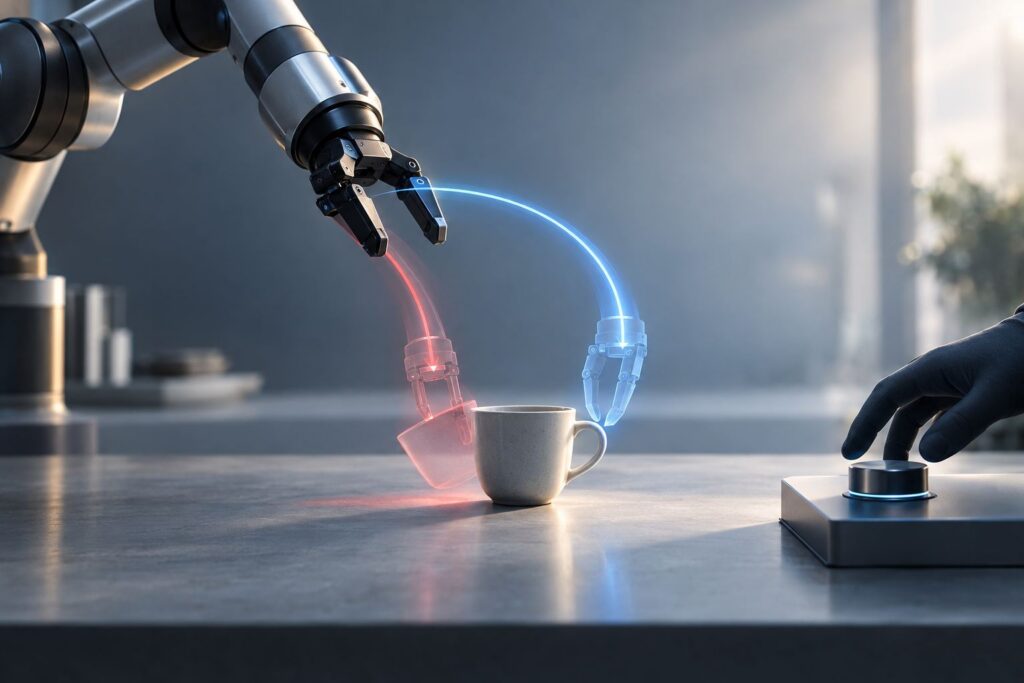
A recent preprint, Tokens of Motion, goes straight at this gap. Its authors propose a framework they call Adaptive Failure-Informed Learning, which treats failed attempts as a training signal in their own right: a pretrained policy generates its own failed rollouts, a second generator is trained on those alongside one trained on successes, and during motion generation the system is steered away from the regions that look like trouble.
The authors report that the approach consistently improves task success rates and robustness over existing baselines across both short and long tasks, in and out of the domain it was trained on. They describe it as a consistent gain rather than a single headline figure, which for anyone funding robots is still the cheapest kind of progress available: more reliability out of the same hardware and the same human demonstrations.
I think the deeper implication here is about data, not algorithms. Failure is only useful as a signal when you can tell it apart from success, and in the physical world that line is far blurrier than a success rate makes it sound. A robot that puts the box on the shelf while crushing one corner has succeeded by the scoreboard and failed by any standard a customer would recognise. I would watch how teams define failure before I watch how they learn from it.
A Failure Only Counts When Someone Says So
In simulation, this problem is tractable, because the simulator knows where everything is and can score the run automatically. On real hardware there is no oracle. Someone has to watch the recording and make a call: did this attempt fail, at what moment did it begin to fail, and was the cause the grasp, the perception, the surface, or the instruction itself. That judgement is the thing a failure corpus is actually made of, and it has to be applied the same way across thousands of runs by many different people, or the resulting labels teach the model nothing but the inconsistency of its annotators.
Keeping failures deliberately also costs more than throwing them away. You need the same calibrated sensing, the same synchronised clocks and the same taxonomy on the bad runs as on the good ones. Serving that kind of work requires trained, managed, quality-controlled human capacity, the sort that can be held to a demanding production standard day after day. We have that capability through our acquisition of Flipside Digital Content Company, Inc., our Philippines-based operating subsidiary.1
The field is only beginning to write down what a failure record should contain. A video of a dropped object is close to worthless on its own. The same clip, time-stamped against the robot’s own sensor stream and annotated by someone who can say which of four things went wrong, is a training example. That difference is a production discipline, not a modelling choice.
What A Corpus Of Mistakes Has To Prove
The practical test for any of this is reuse. A failure set built for one gripper on one bench, labeled by one team’s private intuitions, dies with that project. A failure set built against a published taxonomy, with consistent timing and consistent judgement, can be pooled, audited and handed to the next group that needs it. The second kind is harder to produce, and almost nobody is producing it yet at any serious scale.
I think the industry spent several years assuming robots were held back by their models, when the honest answer is that they have been trained on an edited highlight reel. Teaching a machine to recover means showing it what going wrong looks like, in detail, labeled by people who know the difference. Robots are not short of intelligence so much as short of an accurate record of reality, mistakes included.
Sources
- Flipside AI: A Transformational Acquisition, 8-K, filed 2026-08-17
Disclosure
The following cautionary statement is reproduced from a Quarterly Report on Form 10-Q filed with the SEC.
Certain information included in this Quarterly Report on Form 10-Q and other filings of the Registrant under the Securities Act of 1933, as amended (the “Securities Act”), and the Securities Exchange Act of 1934, as amended (the “Exchange Act”), as well as information communicated orally or in writing between the dates of such filings, contains or may contain “forward-looking statements” within the meaning of Section 27A of the Securities Act and Section 21E of the Exchange Act. Forward-looking statements in this Quarterly Report on Form 10-Q, including without limitation, statements related to our plans, strategies, objectives, expectations, intentions and adequacy of resources, are made pursuant to the safe harbor provisions of the Private Securities Litigation Reform Act of 1995. Such statements are subject to certain risks, trends and uncertainties that could cause actual results to differ materially from expected results. Among these risks, trends and uncertainties are the availability of working capital to fund our operations, the competitive market in which we operate, the efficient and uninterrupted operation of our computer and communications systems, our ability to generate a profit and execute our business plan, the retention of key personnel, our ability to protect and defend our intellectual property, the effects of governmental regulation, and other risks identified in the Registrant’s filings with the Securities and Exchange Commission from time to time.