Robot policies break in the situations nobody recorded, and the newest ideas attack how demonstrations are collected rather than how the models are trained.
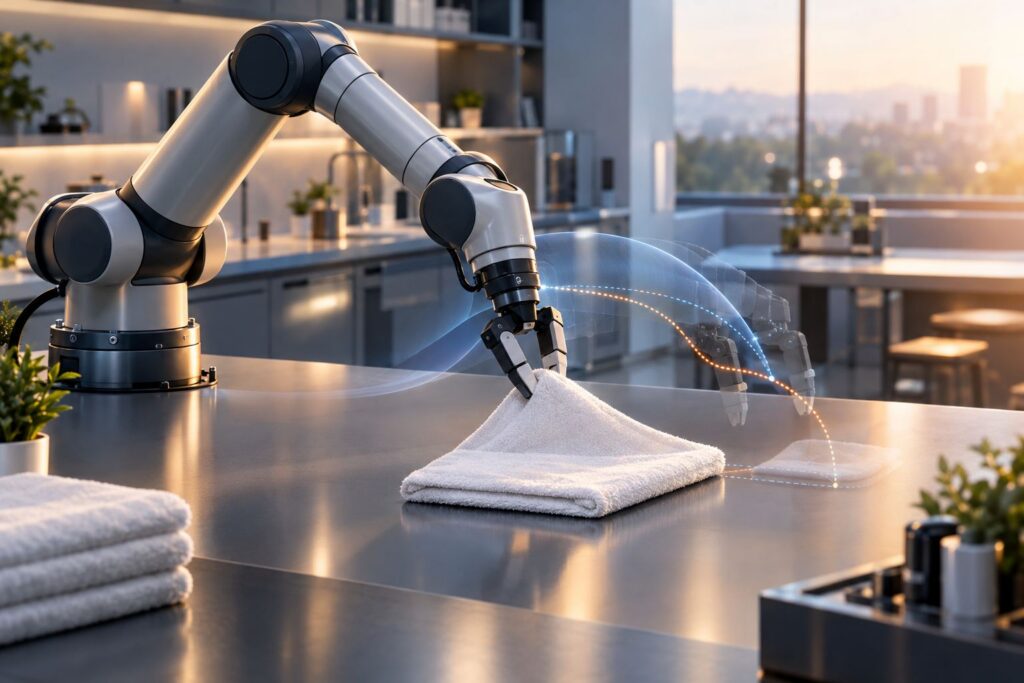
A robot that folds a towel perfectly in a lab video and fumbles the same towel in a kitchen is rarely suffering from a weak model. It is suffering from a thin record. A system that learns by imitating people only knows the situations someone bothered to show it, and the awkward ones are precisely the ones nobody films. Human teleoperators are good at their jobs, which is the problem: they drive the clean path, the dataset fills up with clean paths, and the learner never sees what happens three inches to the left of competence.
The Flaw In Flawless Demonstrations
The technical name for the consequence is compounding error. A trained policy drifts slightly from the demonstrated motion, that drift puts it in a state no demonstration covered, its next action is worse because it is now guessing, and within a few steps the robot is somewhere the data cannot help it. Coverage, not model size, is what decides whether the machine recovers or freezes. The field has known this for years and has mostly handled it with heuristics: tell the operator to vary the starting position, tell them to try it messy, hope the variety lands in the right places.
The alternatives have real costs. Letting a robot explore on its own gathers useful failures, at the price of safety and an enormous number of attempts. Letting a trained policy drive while a human takes over when it stumbles means waiting for the robot to fail by chance before anyone can demonstrate a recovery.
A recent preprint called Robotic Data Inoculation proposes something different: keep the human in continuous control, and have a learned residual policy perturb their commands while they work, steering the robot toward the kinds of deviations a future policy would make. The human corrects in real time, and those corrections become recovery demonstrations. On three real-world manipulation tasks, the authors report that policies trained on this perturbed data matched or beat policies trained on conventionally collected data, under both imitation learning and offline reinforcement learning. For anyone building or backing robots, that is a claim that you can improve the model without touching the model.
The Operator Becomes Part Of The Instrument
I find the framing genuinely clever, because it inverts who is being trained. The human is no longer a source of perfect examples. The human is a recovery engine, deliberately provoked, and the dataset’s value comes from how they respond to being thrown off. To me, that quietly raises the bar on the collection side rather than lowering it. A heuristic instruction sheet can be handed to anyone. A session where the robot is actively fighting you, and every correction you make becomes a training label, needs an operator who stays consistent under pressure.
I would watch how this holds up over long production runs rather than in three tasks. Perturbation is a knob, and a knob that is set too high produces chaos nobody can recover from, while one set too low produces the same clean data at greater expense. The judgment about where that knob sits, and about which recovery attempts are good enough to keep, is human judgment applied thousands of times with the same standard. That is a quality-management problem wearing a research paper’s clothes.
What Stays Scarce
Follow the logic to its end and the scarce input in embodied AI is not the shared-control algorithm, which anyone can read and reimplement. It is trained, managed, quality-controlled human capacity, running many hours of instrumented closed-loop control to a consistent production standard. We have that capacity through our acquisition of Flipside Digital Content Company, Inc., our Philippines-based operating subsidiary, and through Flipside we now own that capacity rather than renting it.1 Flipside specializes in structured data collection, human-in-the-loop judgment workflows, and quality-controlled curation pipelines.2
Zoom out and a pattern across the last year of robot learning research becomes hard to miss. Almost every advance that moves real success rates moves them by changing what gets recorded and how, not by changing the architecture that consumes it. Simulation fidelity, calibration motions, failure records, and now the very behavior of the robot during teleoperation are all upstream of the model. The models have become the commodity. The physically grounded, task-annotated record of how things actually go, including how they go wrong and how a skilled person pulls them back, has not.
I think the most useful idea in this line of work is that a dataset can be designed rather than merely gathered. Once you accept that, the question facing a robotics program stops being which model to license and becomes whether anyone involved can produce the hard experiences repeatedly, with the same standard applied on the thousandth session as on the first. The algorithms keep improving on their own; a record of how a skilled person recovers from trouble does not exist unless someone sets out to make it.
Sources
- Flipside AI: A Transformational Acquisition, 8-K, filed 2026-08-17
- (exhibit EX-99.1: PRESS RELEASE), 8-K, filed 2026-01-14
Disclosure
The following cautionary statement is reproduced from a Quarterly Report on Form 10-Q filed with the SEC.
Certain information included in this Quarterly Report on Form 10-Q and other filings of the Registrant under the Securities Act of 1933, as amended (the “Securities Act”), and the Securities Exchange Act of 1934, as amended (the “Exchange Act”), as well as information communicated orally or in writing between the dates of such filings, contains or may contain “forward-looking statements” within the meaning of Section 27A of the Securities Act and Section 21E of the Exchange Act. Forward-looking statements in this Quarterly Report on Form 10-Q, including without limitation, statements related to our plans, strategies, objectives, expectations, intentions and adequacy of resources, are made pursuant to the safe harbor provisions of the Private Securities Litigation Reform Act of 1995. Such statements are subject to certain risks, trends and uncertainties that could cause actual results to differ materially from expected results. Among these risks, trends and uncertainties are the availability of working capital to fund our operations, the competitive market in which we operate, the efficient and uninterrupted operation of our computer and communications systems, our ability to generate a profit and execute our business plan, the retention of key personnel, our ability to protect and defend our intellectual property, the effects of governmental regulation, and other risks identified in the Registrant’s filings with the Securities and Exchange Commission from time to time.