As humanoid training moves into fully virtual pipelines, the scarce ingredient becomes the measured, rights-cleared 3D worlds those pipelines start from.
Most of the cost of teaching a humanoid anything sits in the setup. Someone has to build the room, instrument the actor, calibrate the cameras and drive the robot through the motion, and then do the whole thing again for the next object and the next staircase. That is why demonstrations for whole-body tasks have stayed expensive even as training models has become routine.
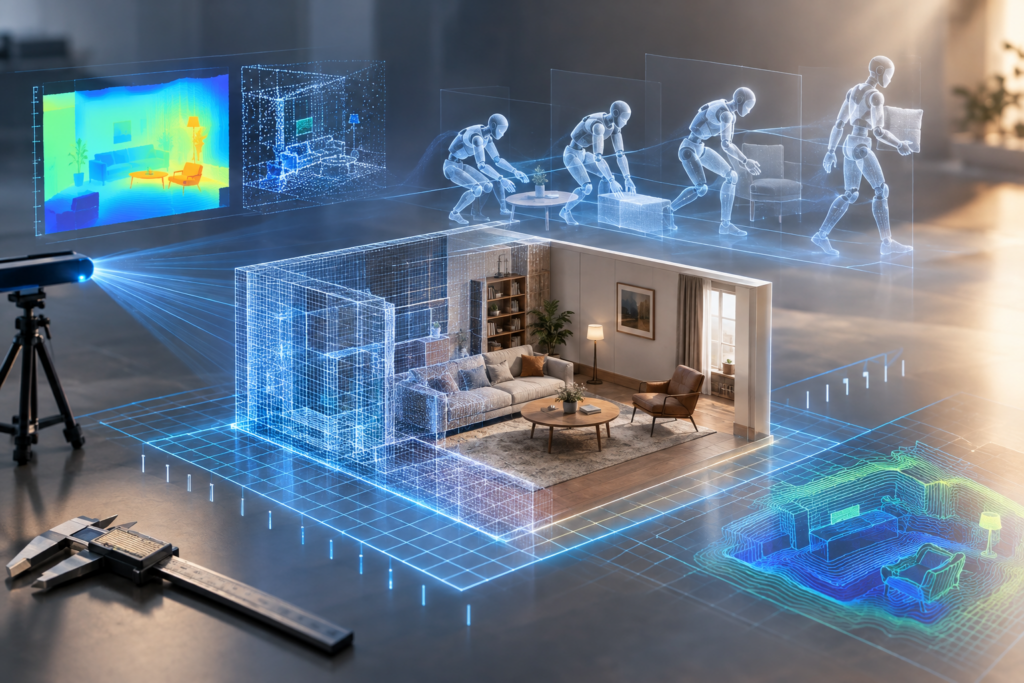
A recent paper called GRAIL goes at that cost by staying virtual for as long as possible. Its authors describe a generation pipeline that grounds video world models in 3D assets and simulator-ready scenes, retargets the recovered motion onto a humanoid, and trains policies on what comes out. They report 84% real-world success on diverse object pick-up using only generated data, which, if it holds elsewhere, means a team can reach a working skill without ever staging the physical scene.
What Has To Be True Before The Video Model Runs
The part worth slowing down on is what the pipeline needs before it can generate anything at all. It does not start from unconstrained video pulled off the internet. It starts from fully specified 3D configurations in which object geometry, camera parameters, metric scale, environment depth and the proportions of a robot-shaped character are known in advance, and those same quantities are reused when the motion is reconstructed afterwards.
I think that inversion is the real news, and it is the opposite of how the result reads at first glance. The generation is virtual. The inputs are measurements of real things, and the quality of the output is bounded by the quality of those measurements. I would watch asset coverage rather than sequence counts: how many objects, how many scene geometries, how faithfully scaled. A virtual pipeline moves the measurement problem upstream rather than making it go away, and I find that the honest reading of this kind of result.
When The Scene Library Becomes The Product
That upstream shift changes the economics in a way I find genuinely interesting. A staged collection run is consumed once: you get the trajectories you captured, in the lighting you had, with the objects you brought. A measured scene behaves differently, because the same geometry can be restaged with new objects, new motions and new camera positions, and each pass costs compute rather than floor time.
That turns a library of accurately measured objects and environments into the thing with lasting worth, which raises questions the field has barely begun to answer. Who holds the rights to the scan of a real kitchen, and do those rights travel with every sequence generated from it? Just as pressing, who decides that a generated interaction is physically plausible before it becomes training data? That last judgement is still human work, and it has to be applied consistently across tens of thousands of sequences or the dataset quietly rots.
Who Does The Measuring
Measuring the world, keeping the rights straight and indexing the result so it can be used more than once is a different kind of operation from running a capture studio, and it is closer to building a library than to staffing a shoot. We have formed TaskAlpha Pte., Ltd. in Singapore to host our core data-collection platform.1 We call AlphaCortex our AI training-data catalog.1 Across the field there is still no common way to describe how a scene was measured or how a synthetic sequence was checked, so buyers are left trusting whoever produced the data.
I keep coming back to the same point when I read results like this one. Virtual generation does not remove the dependence on physically grounded, task-annotated data. It concentrates that dependence into fewer, more consequential acts of measurement, where a bad scale or a sloppy label propagates into thousands of sequences instead of one. The models are not the scarce thing. The accurately described world they learn from still is, and someone has to go out and describe it.
Sources
- From Services to Proprietary Data Infrastructure, 8-K, filed 2026-08-17
Disclosure
The following cautionary statement is reproduced from a Quarterly Report on Form 10-Q filed with the SEC.
Certain information included in this Quarterly Report on Form 10-Q and other filings of the Registrant under the Securities Act of 1933, as amended (the “Securities Act”), and the Securities Exchange Act of 1934, as amended (the “Exchange Act”), as well as information communicated orally or in writing between the dates of such filings, contains or may contain “forward-looking statements” within the meaning of Section 27A of the Securities Act and Section 21E of the Exchange Act. Forward-looking statements in this Quarterly Report on Form 10-Q, including without limitation, statements related to our plans, strategies, objectives, expectations, intentions and adequacy of resources, are made pursuant to the safe harbor provisions of the Private Securities Litigation Reform Act of 1995. Such statements are subject to certain risks, trends and uncertainties that could cause actual results to differ materially from expected results. Among these risks, trends and uncertainties are the availability of working capital to fund our operations, the competitive market in which we operate, the efficient and uninterrupted operation of our computer and communications systems, our ability to generate a profit and execute our business plan, the retention of key personnel, our ability to protect and defend our intellectual property, the effects of governmental regulation, and other risks identified in the Registrant’s filings with the Securities and Exchange Commission from time to time.