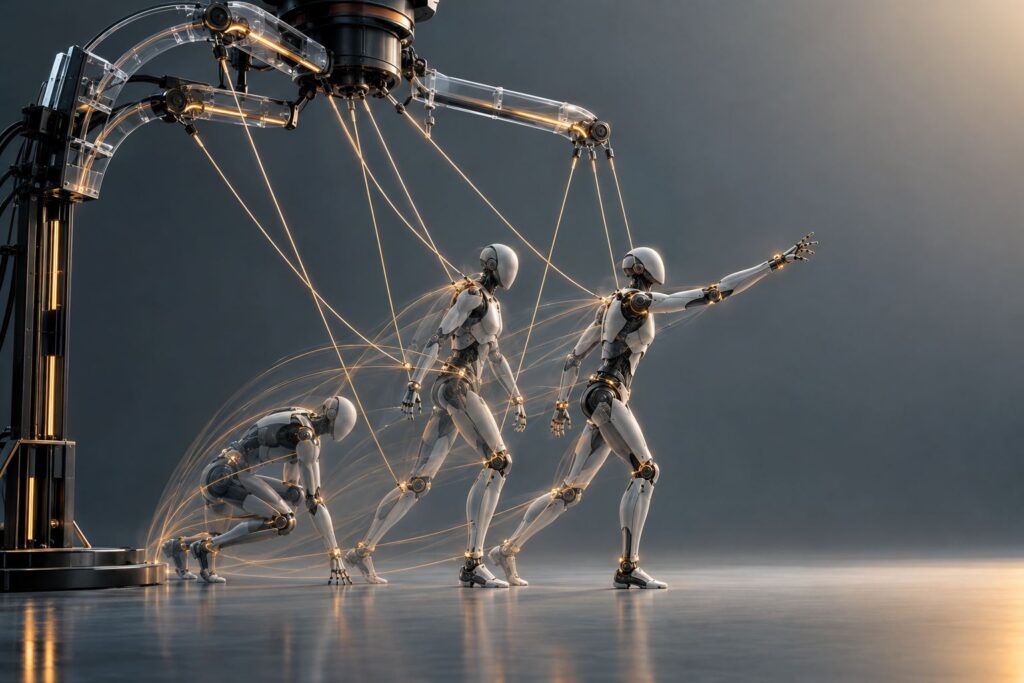
As humanoids move out of cages and into shared space, success stops being task completion and starts being how the person nearby felt about it.
For most of the last decade, robot competence has been scored by whether the job got done. Did the gripper close on the cup, did the box land on the pallet, did the policy get through the whole sequence without a reset. That scoring system works perfectly well when the machine is behind a fence. It falls apart the moment a person is standing inside the robot’s working space, because now there are two outcomes that matter and only one of them shows up in the task log.
Safety Near People Is A Judgment Call
A humanoid handing someone a tool is doing two things at once. The physical part is familiar: find the handle, control the force, do not drop it. The social part is the one nobody has a clean number for. How fast it approaches, how close it stands, where it looks, whether it pauses when the person hesitates or pushes through because the sequence said to keep going. A robot can finish that handover flawlessly and still leave the human beside it rattled, and from a deployment standpoint that is a failure even though every log says otherwise.
That second job is what AffectiveVLA takes on. The work asks a vision-language-action model, the kind of system that turns a camera feed and an instruction into motion, to read the person’s apparent emotional state and intent as part of control rather than as a courtesy layer bolted on afterward. The authors report that a controller built this way behaves more safely and more appropriately around people than one driven by the task instruction alone.
For anyone building or backing humanoids, the practical reading is that the behavior a customer judges the machine on now lives inside the policy, which means it has to live inside the training data too. I am treating the work as background rather than as settled evidence, because I have not worked through its testing myself and nobody should take a fresh result on faith.
I think the interesting admission is the one buried in the framing. If reading intent and emotional state belongs inside the control policy, then the policy has to be trained on examples of people reacting to machines, not just on examples of machines completing tasks. I find that a much harder data problem than it sounds. Collision avoidance has physics behind it, and physics does not argue. Discomfort has no sensor, and the only instrument that reads it is another person.
Who Writes The Ground Truth For Social Behavior
Where does that ground truth actually come from. It comes from humans watching recordings of interactions and saying, in a structured and repeatable way, that this approach was fine and that one was startling, that the robot read the hesitation correctly here and missed it there. The hard part is not collecting the footage. It is getting a room full of annotators to agree, against a written standard, on calls that reasonable people see differently, and to keep agreeing across thousands of clips, across shifts, across months. Social norms also vary by setting and by region, which means the guideline itself is a piece of engineering, not a formality.
This is why I keep saying the constraint in embodied intelligence sits below the model. Any lab can read a new paper and reimplement an architecture in a few weeks. Almost nobody can stand up a production operation that turns messy human reactions into consistent, audited labels at the volume a frontier training run consumes. Serving sophisticated developers in this category takes trained, managed, quality-controlled human capacity that meets demanding production standards. Through Flipside, we now own that capacity rather than renting it.1 We deliver embodied intelligence services through vertically integrated infrastructure spanning high-quality data collection, supervised annotation, and AI training data delivery for frontier AI labs, humanoid robotics manufacturers, and autonomous mobility clients worldwide.2
What I Would Watch Next
The thing worth watching in socially aware control is not the architecture diagram. It is whether the field builds honest assessment for it. Task success is easy to measure and easy to game. Whether a bystander trusted the machine is neither, and until there are shared protocols for capturing that, every claim about a socially safe humanoid rests on whoever labeled the clips and how carefully they were trained.
My guess is that the groups who get this right treat annotation guidelines with the same seriousness they give to model code: versioned, argued over, tested for inter-annotator agreement, revised when the disagreements cluster. That is unglamorous work, and it is the work that decides whether a humanoid can stand next to a person in a warehouse or a hospital corridor.
I think this is the pattern that keeps repeating as robotics gets closer to people. Every time the field reaches for a more human-shaped capability, the thing it actually needs is a more careful record of human behavior and human judgment. The models are moving fast. The ground truth underneath them is what the whole thing is waiting on.
Sources
- Flipside AI: A Transformational Acquisition, 8-K, filed 2026-08-17
- (exhibit EX-99.2: PRESS RELEASE), 8-K, filed 2026-08-17
Disclosure
The following cautionary statement is reproduced from a Quarterly Report on Form 10-Q filed with the SEC.
Certain information included in this Quarterly Report on Form 10-Q and other filings of the Registrant under the Securities Act of 1933, as amended (the “Securities Act”), and the Securities Exchange Act of 1934, as amended (the “Exchange Act”), as well as information communicated orally or in writing between the dates of such filings, contains or may contain “forward-looking statements” within the meaning of Section 27A of the Securities Act and Section 21E of the Exchange Act. Forward-looking statements in this Quarterly Report on Form 10-Q, including without limitation, statements related to our plans, strategies, objectives, expectations, intentions and adequacy of resources, are made pursuant to the safe harbor provisions of the Private Securities Litigation Reform Act of 1995. Such statements are subject to certain risks, trends and uncertainties that could cause actual results to differ materially from expected results. Among these risks, trends and uncertainties are the availability of working capital to fund our operations, the competitive market in which we operate, the efficient and uninterrupted operation of our computer and communications systems, our ability to generate a profit and execute our business plan, the retention of key personnel, our ability to protect and defend our intellectual property, the effects of governmental regulation, and other risks identified in the Registrant’s filings with the Securities and Exchange Commission from time to time.