As world models begin to transfer across different robot bodies, the scarce asset becomes human experience captured carefully enough to survive that translation.
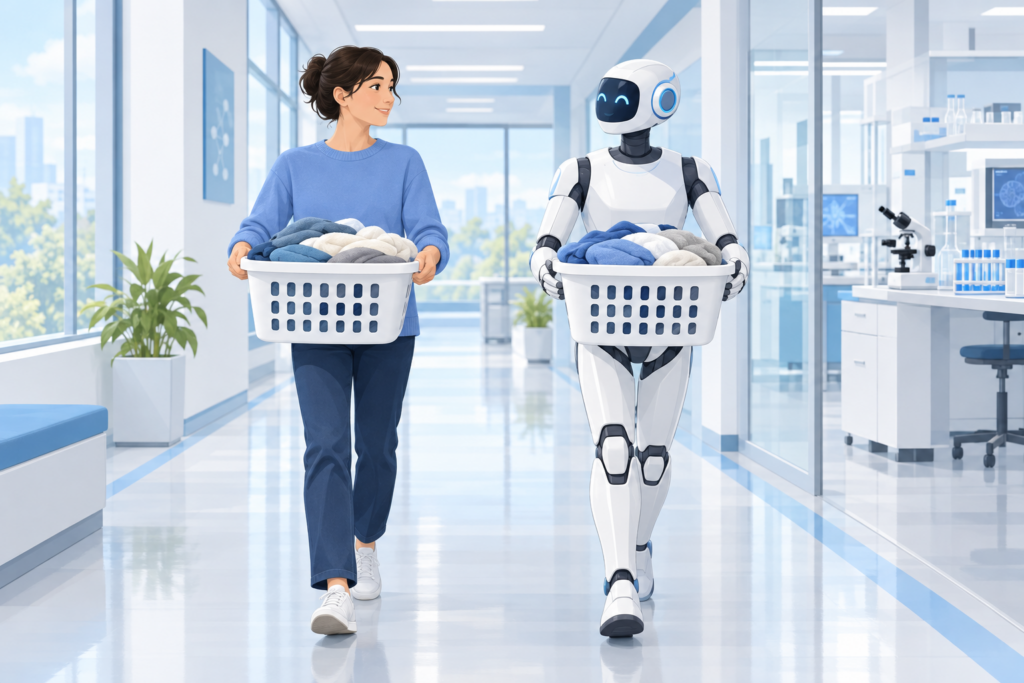
Pick up a laundry basket and walk it down a hallway. Your grip shifts as your weight shifts, you lean back slightly, you slow at the corner, and none of it feels like two separate skills. For a robot it usually is two separate skills, learned apart and stitched together badly at the seam. The field has a name for doing both at once, loco-manipulation, and it matters because almost all useful physical work involves a body that moves while the hands do something real.
Walking And Handling Are One Problem
Ropedia W0 goes at that problem from an angle worth a non-technical reader’s attention: what a robot can learn from the way people already do this kind of work. Its stated concern is scaling loco-manipulation world models across embodiments, using human experience as the source material. A world model, in plain words, is a model that learns what happens next: if the body does this, the world responds like that. Build a good one and the robot stops reacting frame by frame and starts behaving as though it understands what it is holding.
The word in that title I keep returning to is embodiments. I think cross-body transfer is the quiet dividing line in robotics right now, because a demonstration recorded on one machine does not simply drop into another with different limb lengths, different joint limits and a different center of mass. To me, the interesting claim in any work of this kind is not that a policy performs well on the robot it was trained on. It is whether the experience behind it survives being moved onto a body it has never met. That is the result I would watch for, and it is a much harder thing to show than a single impressive demonstration.
Human Experience Is Not A Free Resource
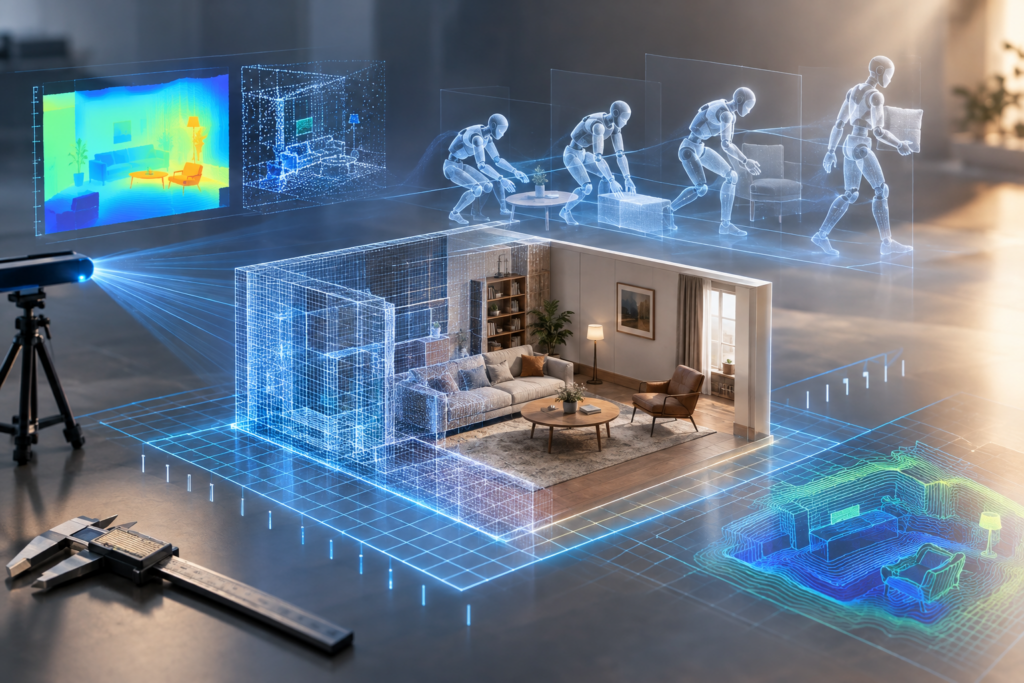
Here is the part that gets skipped. “Human experience” sounds like something abundant, because the internet is full of people doing things on camera. The record a world model needs is not that. It needs to know what the person was trying to accomplish, when contact began and ended, which object moved and how, where the attention went, and whether the attempt actually worked. Ordinary video carries none of that. It has to be captured deliberately, with instrumentation, and then judged by people who understand the task well enough to say what each moment was.
Consistency is the other half, and it is the half that quietly decides whether any of this scales. If two capture sessions in two rooms define the start of a grasp differently, a model trained across both learns the disagreement along with the task. Somebody has to run that capture, hold it to a single standard, and get it into the hands of the teams training the models. We deliver embodied intelligence services through vertically integrated infrastructure spanning high-quality data collection, supervised annotation, and AI training data delivery for frontier AI labs, humanoid robotics manufacturers, and autonomous mobility clients worldwide.1
Nothing about that work is glamorous, and that is rather the point. The models are published, the architectures are discussed openly at every conference, and the hardware keeps getting cheaper. The grounded human record underneath is the part nobody can download.
What Transfers And What Does Not
Think about what can actually move from one body to another. Joint trajectories cannot: they are facts about a specific machine. What can travel is the structure of the task, meaning the sequence of intentions, the contact events, the state of the object, the moment where a person adjusted because the load shifted. Those are descriptions of the world and of a goal, not of a particular set of motors.
That has a practical consequence for anyone collecting data today. Recording in a body-independent way, where the labels describe what was happening rather than what one robot’s joints were doing, is what makes a corpus reusable when the next generation of hardware arrives. Capture tied too tightly to one machine ages out with that machine. Capture organized around intent and contact keeps paying as the bodies change around it.
I think the field is in the middle of a shift it has not fully named yet. For a decade the question was whether a model could learn a physical skill at all, and now the question is whether the experience behind that skill is portable, consistent and rich enough to be worth keeping. Models are getting easier to build every month. The grounded record of how work is actually done is not, and that is where the real scarcity sits.
Sources
- (exhibit EX-99.2: PRESS RELEASE), 8-K, filed 2026-08-17
Disclosure
The following cautionary statement is reproduced from a Quarterly Report on Form 10-Q filed with the SEC.
Certain information included in this Quarterly Report on Form 10-Q and other filings of the Registrant under the Securities Act of 1933, as amended (the “Securities Act”), and the Securities Exchange Act of 1934, as amended (the “Exchange Act”), as well as information communicated orally or in writing between the dates of such filings, contains or may contain “forward-looking statements” within the meaning of Section 27A of the Securities Act and Section 21E of the Exchange Act. Forward-looking statements in this Quarterly Report on Form 10-Q, including without limitation, statements related to our plans, strategies, objectives, expectations, intentions and adequacy of resources, are made pursuant to the safe harbor provisions of the Private Securities Litigation Reform Act of 1995. Such statements are subject to certain risks, trends and uncertainties that could cause actual results to differ materially from expected results. Among these risks, trends and uncertainties are the availability of working capital to fund our operations, the competitive market in which we operate, the efficient and uninterrupted operation of our computer and communications systems, our ability to generate a profit and execute our business plan, the retention of key personnel, our ability to protect and defend our intellectual property, the effects of governmental regulation, and other risks identified in the Registrant’s filings with the Securities and Exchange Commission from time to time.