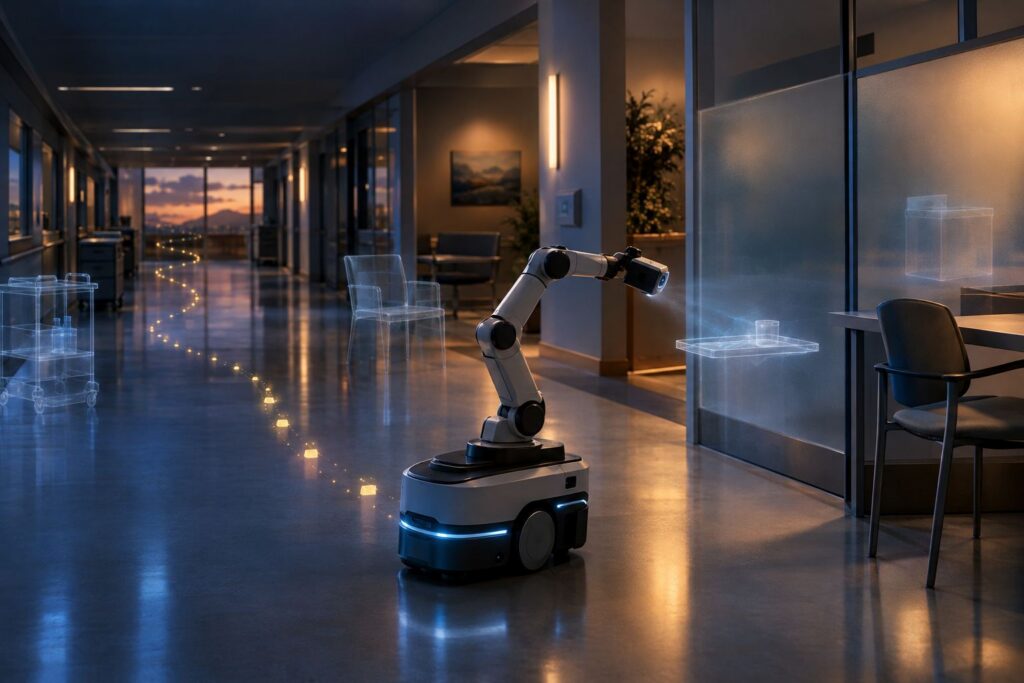
As embodied agents are asked to act on what they can no longer see, the scarce input shifts from clean single demonstrations toward long, consistently annotated records of change.
Most robot demonstrations that circulate online last under a minute. The task starts, the arm moves, the object lands where it should, and the clip ends before anything in the room has had a chance to change. Real work does not run on that clock. A machine tidying a warehouse aisle or carrying a tray down a hospital corridor has to act on things it saw ten minutes ago and cannot see now, in a building where other people keep moving the furniture. The conversation in embodied AI has turned toward that problem, and it is a more interesting one than it first sounds.
A recent survey called When the Past Shapes Action takes that problem as its subject. The authors report no benchmark score: their result is a map, sorting what an agent needs to remember into six requirements, including world-state persistence, task progress and belief maintenance, and sorting the mechanisms built so far into eight architectural families. For anyone building or backing robots, the useful message is that memory is a design choice with costs attached, not something a bigger model supplies for free.
Perception Is A Snapshot, Memory Is A Record
Perception answers what is in front of the camera. Memory answers what is true about the room, what part of the job is already done, and what the machine thought it knew that has since stopped being true. Those are different jobs, and the field has attacked them in very different ways: hidden states carried forward inside a network, maps that hold where things were, symbolic notes about progress through a long task, and libraries of past attempts a system can look things up in. Each approach keeps something and throws away a great deal else, which is the whole difficulty. Forgetting is not a bug to be removed. It is a choice about what counts as decision-relevant.
I think the sharpest question in this area is not architectural at all, it is about measurement. A robot can score well on a long task because the task is easy to brute force, not because it used anything it saw earlier, and from the outside those two look identical.
What I would watch is whether testing gets good at separating them: changing the room between visits, hiding the object after the robot has seen it, asking for a job that cannot be finished without a fact acquired twenty steps ago. To me, belief maintenance is the hardest of the lot, because a system that holds a stale fact with confidence behaves worse than one that admits it does not know.
Memory Has To Be Trained On Somebody’s History
Here is where this lands commercially. A memory mechanism is only as good as the histories it is trained and tested against, and those histories are a very particular kind of data. They are long rather than short. They revisit the same space after something in it has moved. They carry marks for when a belief should have been revised, for when a sub-task was genuinely complete, and for which earlier moment actually mattered to a later decision. None of that falls out of a camera roll. Somebody has to decide, consistently, across thousands of episodes, what the robot should have remembered.
Producing that kind of record at scale takes trained, managed, quality-controlled human capacity rather than a scraper and a storage bucket. Through Flipside, we now own that capacity rather than renting it.1 Over the past several months, we have secured engagements across three of the most important areas of embodied intelligence: humanoid robotics, autonomous mobility, and autonomous vehicles.2
The Part Nobody Can Automate Away
The open problems people point to in embodied memory all have the same shape underneath. Choosing which past experience is worth retrieving, keeping beliefs consistent while the world moves, consolidating what one episode taught into something the next episode can use: each of those requires a reference standard for what the right answer was. Models can propose that standard. They cannot be the judge of it, because a model’s own guess about what mattered is exactly the thing under test. The judgment has to come from outside the system, recorded at the time, in a form that means the same thing on episode one and episode ten thousand.
That is why I find memory a more honest stress test of the field than most benchmark results. It forces everyone to confront how little of what a robot needs to know is available in a single frame, and how much of it has to be deliberately produced by people watching the world change and writing down what changed. I think the teams that treat their records as the product, rather than as the exhaust from a training run, are the ones whose machines still earn their place on the second day in a room.
Sources
- Flipside AI: A Transformational Acquisition, 8-K, filed 2026-08-17
- Building Our Leadership Team for Scale, 8-K, filed 2026-08-17
Disclosure
The following cautionary statement is reproduced from a Quarterly Report on Form 10-Q filed with the SEC.
Certain information included in this Quarterly Report on Form 10-Q and other filings of the Registrant under the Securities Act of 1933, as amended (the “Securities Act”), and the Securities Exchange Act of 1934, as amended (the “Exchange Act”), as well as information communicated orally or in writing between the dates of such filings, contains or may contain “forward-looking statements” within the meaning of Section 27A of the Securities Act and Section 21E of the Exchange Act. Forward-looking statements in this Quarterly Report on Form 10-Q, including without limitation, statements related to our plans, strategies, objectives, expectations, intentions and adequacy of resources, are made pursuant to the safe harbor provisions of the Private Securities Litigation Reform Act of 1995. Such statements are subject to certain risks, trends and uncertainties that could cause actual results to differ materially from expected results. Among these risks, trends and uncertainties are the availability of working capital to fund our operations, the competitive market in which we operate, the efficient and uninterrupted operation of our computer and communications systems, our ability to generate a profit and execute our business plan, the retention of key personnel, our ability to protect and defend our intellectual property, the effects of governmental regulation, and other risks identified in the Registrant’s filings with the Securities and Exchange Commission from time to time.