If compact control-first policies can match far larger ones, the advantage moves from borrowed generative pretraining toward the demonstrations those policies are trained on.
For the past couple of years, the standard way to build a robot policy has been to start with something enormous that was built for a different job. A video generator or a vision-language model gets adapted into a controller, on the theory that a system which has already seen a great deal of the world must know something useful about acting in it. That theory is now being tested head on, and the results are worth a non-technical reader’s attention because they change what the expensive part of robotics is.
Borrowed Brains Versus Built For Control
A recent preprint called La-JEPA goes at the question directly. Its authors take a pretrained visual encoder, freeze it, and train a small policy network from scratch inside the features that encoder produces, teaching it during training to predict what the world looks like a moment from now at the same time as it predicts the next action. When the robot is actually running, the future-prediction machinery is switched off and only actions come out. Among policies that get no embodied pretraining, the authors report state-of-the-art results on the simulated benchmarks they tested and real-robot success comparable to much larger systems, while using far fewer parameters and running substantially faster.
I think the headline here is not that a small model won. It is that the generative backbone everyone has been inheriting may be mostly dead weight for control, carried along because it was available rather than because it was right for the job. To me, that is a pleasant kind of news for anyone building robots: a policy that is cheap to run is a policy you can put on a machine that has to work all day without a datacenter attached to it.
What A From-Scratch Policy Has To Be Taught
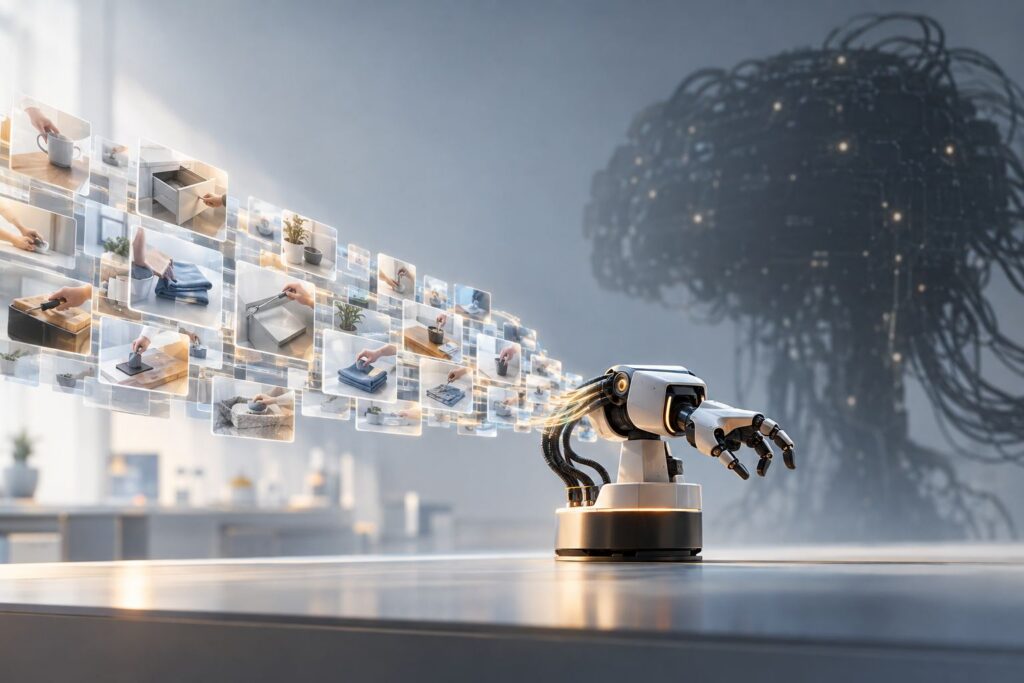
There is a catch, and it is the part I find most interesting commercially. A huge pretrained backbone is, among other things, a crutch. It arrives already knowing what a drawer is, what a cloth looks like when it crumples, which parts of a kitchen move and which do not. Strip that away and train the control network from random weights, and everything the policy knows about the task has to come from the demonstrations you showed it. The burden does not disappear when the model shrinks. It moves onto the data.
That makes the production of demonstrations an operational problem rather than a research one: people trained to perform the task the same way twice, supervisors who check the work, and a standard that holds across thousands of hours of capture. Through Flipside, we now own that capacity rather than renting it.1 Substantially all of our revenue is generated by Flipside AI from data engineering and content services.2
Correcting The Instructions Before Scoring The Robot
Buried in the same work is a detail I would hand to any investor who wants to understand how young this field still is. The authors report that the officially released testing harness for one widely used language-conditioned benchmark corrupts the written instructions for most of its variants, so they fixed the instructions and re-measured several strong open baselines against the corrected version. In plain terms, a chunk of the published scoreboard for instruction-following robots was being graded against garbled instructions.
I would watch how the field responds to that, more closely than I would watch the next architecture. A label defect in a test set is the same species of problem as a label defect in a training set, and both are fixed by the same unglamorous thing: someone checking the ground truth by hand and agreeing on what correct looks like. The research community is getting genuinely good at squeezing competence out of fewer parameters. It is still catching up on whether the yardstick it measures competence with says what it is supposed to say.
The lesson I take from this stretch of work is about the field rather than any one lab. Making a policy smaller does not reduce what a robot has to be taught; it only makes plainer that the teaching comes from recorded human behavior, and that the record has to be right before anything built on it can be trusted. Physically grounded, task-annotated data is the constraint in embodied intelligence, and architecture is the part that keeps moving faster than the ground truth beneath it.
Sources
- Flipside AI: A Transformational Acquisition, 8-K, filed 2026-08-17
- Leases, 10-Q, filed 2026-08-14
Disclosure
The following cautionary statement is reproduced from a Quarterly Report on Form 10-Q filed with the SEC.
Certain information included in this Quarterly Report on Form 10-Q and other filings of the Registrant under the Securities Act of 1933, as amended (the “Securities Act”), and the Securities Exchange Act of 1934, as amended (the “Exchange Act”), as well as information communicated orally or in writing between the dates of such filings, contains or may contain “forward-looking statements” within the meaning of Section 27A of the Securities Act and Section 21E of the Exchange Act. Forward-looking statements in this Quarterly Report on Form 10-Q, including without limitation, statements related to our plans, strategies, objectives, expectations, intentions and adequacy of resources, are made pursuant to the safe harbor provisions of the Private Securities Litigation Reform Act of 1995. Such statements are subject to certain risks, trends and uncertainties that could cause actual results to differ materially from expected results. Among these risks, trends and uncertainties are the availability of working capital to fund our operations, the competitive market in which we operate, the efficient and uninterrupted operation of our computer and communications systems, our ability to generate a profit and execute our business plan, the retention of key personnel, our ability to protect and defend our intellectual property, the effects of governmental regulation, and other risks identified in the Registrant’s filings with the Securities and Exchange Commission from time to time.