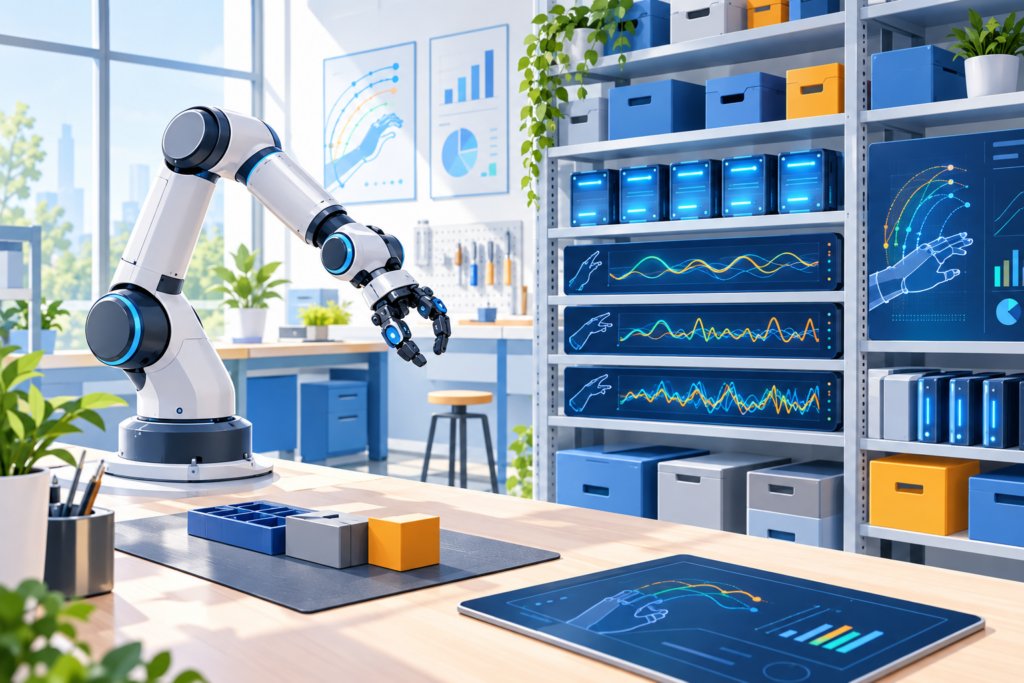
As vision-language-action models move from tidy labs into fields and orchards, the scarce ingredient becomes expert human judgment, captured in season, on living things that will not wait.
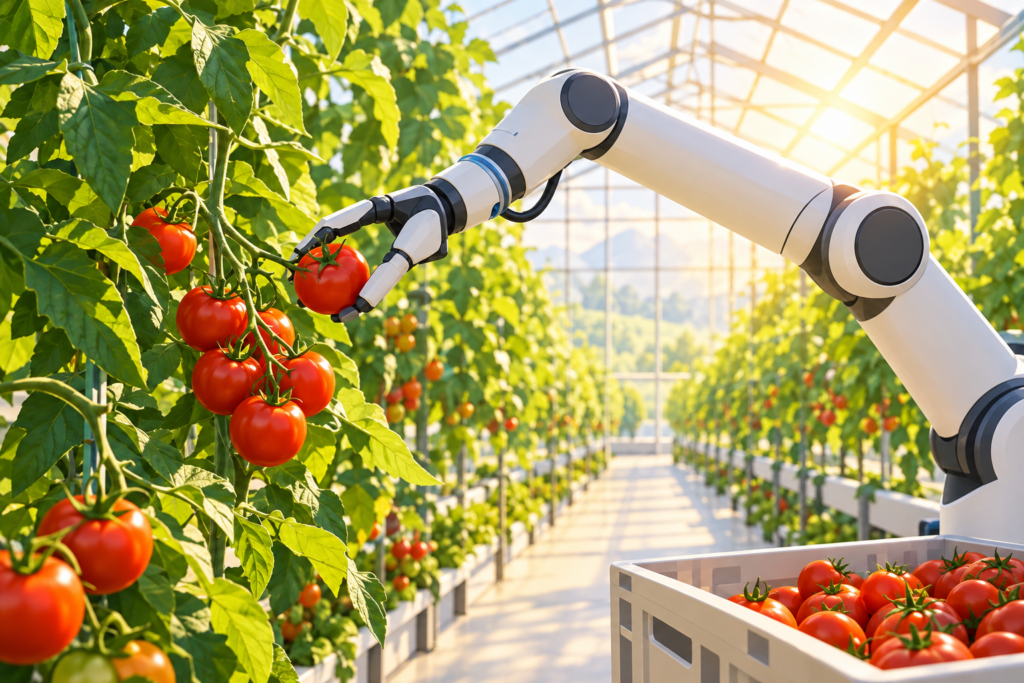
Farming is one of the oldest automation stories in industry, and it is still almost entirely manual at the exact moment a hand meets a plant. Harvesting, thinning, pruning and sorting resist machines because every target is a slightly different shape, in a slightly different place, at a slightly different moment of readiness. The reason this is a live conversation again is that the same models being tested on tabletop manipulation are now being pointed at crops.
A recent paper, Robot Learning with Vision-Language-Action Models for Agricultural Manipulation, pulls that strand of work together. The authors report that vision-language-action models are being adapted to agricultural manipulation tasks such as harvesting and pruning, and that generalizing across crops, seasons and field conditions remains an open problem. For anyone building or backing farm robots, that says the gate is no longer the model architecture.
What A Field Will Not Hand You
Compare a packing warehouse to a strawberry row. The warehouse is built for machines: fixed lighting, rigid objects, known inventory, a floor that does not move. The row is the opposite. Leaves occlude the fruit, wind moves the target between perception and contact, the object is soft enough to bruise, and the cost of a wrong grip is not a retry but a ruined unit of produce. A model that can describe the scene in fluent language still has to close the loop on an object that deforms while it is being held.
The deeper problem is that the experience needed to learn this does not exist anywhere online. There is no archive of a tomato being picked correctly from the gripper’s point of view, under that farm’s light, on that variety, at that stage of the season. Somebody has to go out and record it, and the window for recording it is set by the crop rather than by an engineering schedule. Miss the few weeks when a cultivar is at picking stage and the next chance is a year away. That makes agricultural robot data perishable in a way that very little other training data is.
The Label Is A Judgment, Not A Pixel
I find the ripeness question more interesting than the grasping question. Drawing a box around a fruit is a solved kind of task. Deciding whether that particular fruit should have been picked today, left two days, or culled is an agronomic call, and two experienced pickers on the same row will sometimes disagree. To me, that is the real supervision signal in agricultural manipulation, and it is the part no camera produces on its own. I would watch how teams handle disagreement between human judges, because a model trained on an inconsistent standard learns the inconsistency along with the task.
That means the work sits upstream of the model entirely. Someone has to define what correct looks like for this crop, this grower and this season, then apply it frame by frame across many hours of recorded motion, and keep applying it the same way across many annotators and many months. The skill being encoded is not the robot’s. It is the picker’s, written down in a form a network can absorb.
What the field needs at that point is not another model release. It needs people who apply the same judgment consistently to recorded video, and a pipeline that treats those judgments as the product rather than as a chore. We have that capability through our acquisition of TaskAlpha, which owns Flipside AI, a business providing data curation, annotation and validation services for AI systems, including video and temporal annotation, Vision-Language-Action captioning and reasoning, and data collection.1
Agriculture also exposes something about generalization that cleaner benchmarks hide. A policy that handles one variety of apple in one trellis system has learned a narrow slice of the world, and the next orchard changes the spacing, the pruning style, the ground cover and the colour of the fruit against the leaves. Each of those shifts demands fresh grounded examples, judged by someone who knows what good looks like there.
The Part Of Farm Robotics That Scales Slowly
This is why I am cautious about reading any single field demonstration as a turning point. Hardware and models now move quickly, and a convincing video of a robot arm taking fruit off a plant tells you that the hard engineering is possible, not that it is repeatable across a region, a season and a labour market. The thing that scales slowly is the accumulated, carefully judged record of physical work being done well.
I think agriculture is the clearest test case for embodied intelligence, precisely because it refuses to be tidy. Models keep improving, and they keep arriving at the same gate: somebody has to capture what happened in the physical world and say what it meant. That judged record of real physical work is the ground truth underneath every robot that ever manages to earn its keep in a field.
Sources
- NOTE 1, ORGANIZATION AND DESCRIPTION OF BUSINESS, 10-Q, filed 2026-08-14
Disclosure
The following cautionary statement is reproduced from a Quarterly Report on Form 10-Q filed with the SEC.
Certain information included in this Quarterly Report on Form 10-Q and other filings of the Registrant under the Securities Act of 1933, as amended (the “Securities Act”), and the Securities Exchange Act of 1934, as amended (the “Exchange Act”), as well as information communicated orally or in writing between the dates of such filings, contains or may contain “forward-looking statements” within the meaning of Section 27A of the Securities Act and Section 21E of the Exchange Act. Forward-looking statements in this Quarterly Report on Form 10-Q, including without limitation, statements related to our plans, strategies, objectives, expectations, intentions and adequacy of resources, are made pursuant to the safe harbor provisions of the Private Securities Litigation Reform Act of 1995. Such statements are subject to certain risks, trends and uncertainties that could cause actual results to differ materially from expected results. Among these risks, trends and uncertainties are the availability of working capital to fund our operations, the competitive market in which we operate, the efficient and uninterrupted operation of our computer and communications systems, our ability to generate a profit and execute our business plan, the retention of key personnel, our ability to protect and defend our intellectual property, the effects of governmental regulation, and other risks identified in the Registrant’s filings with the Securities and Exchange Commission from time to time.