If humanoid skills can be learned from people wearing portable rigs, the scarce asset becomes the operation that captures human motion to a standard.
Teaching a humanoid to kneel, squat or toss something has usually required the robot to be standing right there. A person straps into a teleoperation rig, the machine mirrors their movements, and every hour of training data costs an hour on hardware that is scarce, fragile and awkward to move. That constraint quietly decides what robots learn, because skills get collected wherever the hardware happens to live.
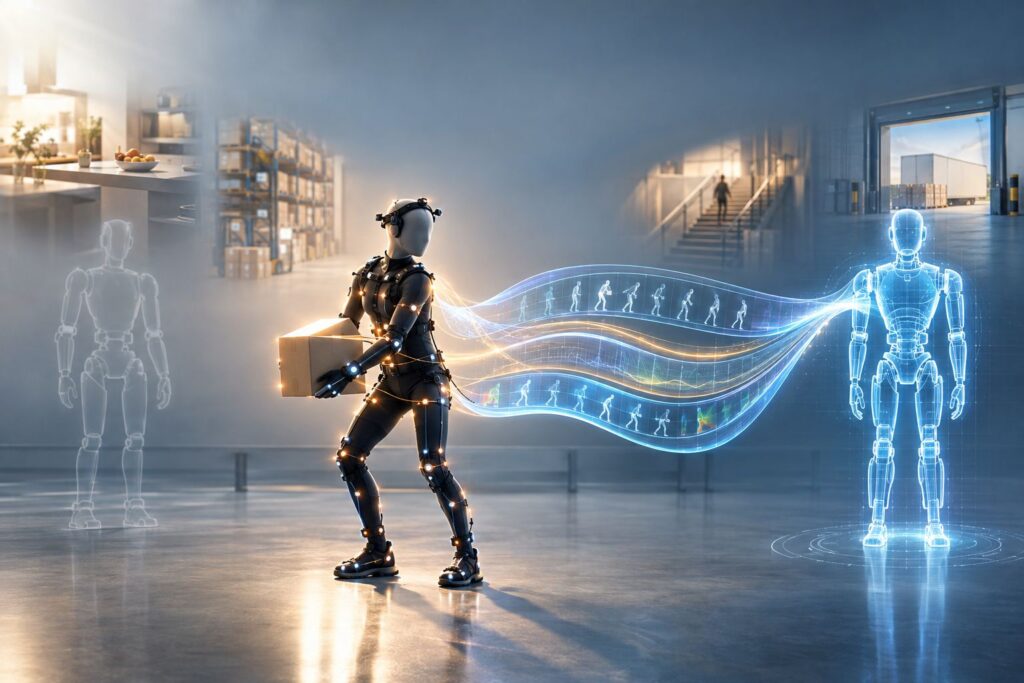
A recent preprint called HuMI takes the robot out of that loop. The researchers describe portable gear that captures a person’s whole-body motion directly, plus a layered learning pipeline that translates those human movements into motions a humanoid can actually execute. The authors report roughly a threefold gain in data collection efficiency over teleoperation, and if that holds up outside the lab, the cost of a new skill stops being tied to the cost of robot time.
Where The Data Can Now Be Gathered
The speed figure is the headline, though the location is the real change. If a demonstration needs only a person and a portable rig, the data can come from kitchens, stockrooms, stairwells and loading bays, places nobody is going to ship a humanoid to for a week of recording. Robot learning has struggled for years with environments it has never seen, partly because so much of its training material comes from a handful of controlled setups that all look alike.
I think the portability matters more than the efficiency gain, because it changes the variety of what gets recorded rather than just the rate. I find that much of the recent progress in robot learning has come from changing how demonstrations are captured instead of changing the learner. To me that is a sign the field has moved past the stage where a better architecture is the obvious next move.
The Constraint Moves To The People Holding The Rig
Taking the robot out of data collection does not take the work out of it. Someone still has to perform the task, repeatedly, correctly, and in a way that is comparable from one operator and one session to the next. Serving developers who train on this material takes trained, managed, quality-controlled human capacity that can hold a production standard across shifts and sites.
Through our Philippines-based operating subsidiary Flipside, we now own that capacity rather than renting it.1 We deliver embodied intelligence services through vertically integrated infrastructure spanning high-quality data collection, supervised annotation, and AI training data delivery.2 Producing records like this at volume is operations work, closer to running a production floor than running a lab.
Human Motion Is Not Yet Robot Motion
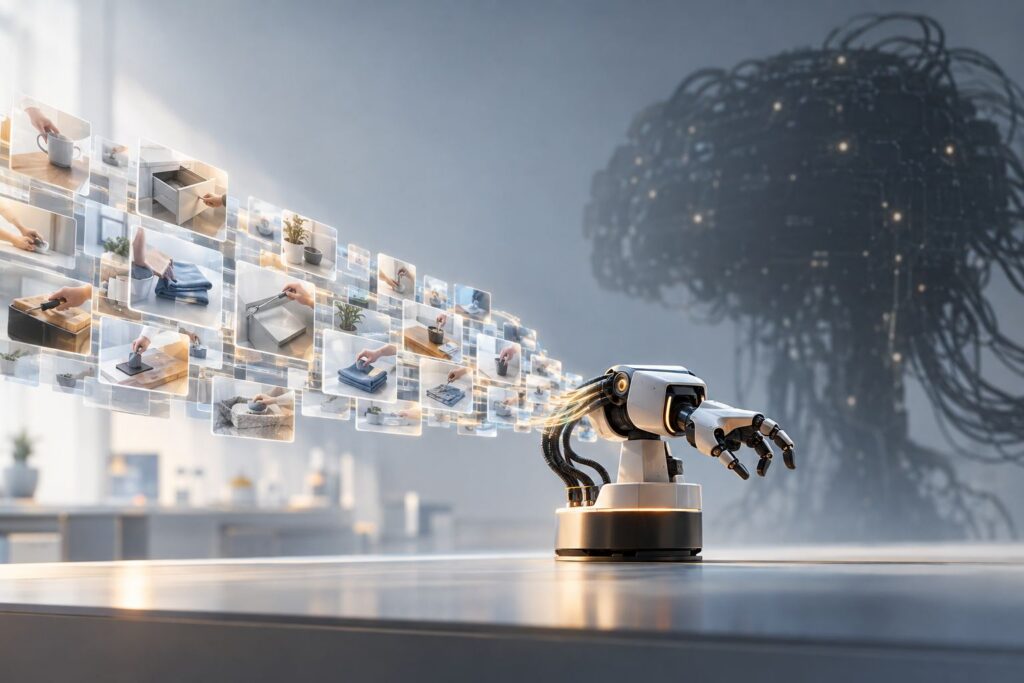
A movement captured on a person is not directly usable by a machine with different joints, different mass and a different sense of balance. That is why the HuMI authors describe a layered pipeline rather than one model: the human movement has to be converted into something the humanoid can hold itself up under. The distance between a motion that looks right and a motion that stays on its feet is where most of the engineering sits, and it is also why the captured record has to be rich enough to survive that conversion.
Raw motion on its own is rarely enough either. The records that train and test these systems need to say what the person was trying to do, where one stage of the task ended and the next began, and what counted as a failure. No capture rig produces that by itself. It comes from human judgment applied consistently, which is the least glamorous and most reusable part of the whole exercise.
Every advance in how robots learn seems to shift the effort rather than remove it. Simulation moved it into calibration, imitation learning moved it into demonstrations, and humanoid-free capture moves it into the people performing tasks in real rooms and the standards governing how their work is recorded. The hardest part of embodied intelligence is still producing careful, physically grounded, task-annotated accounts of ordinary human activity, and nothing in this generation of results has changed that.
Sources
- Flipside AI: A Transformational Acquisition, 8-K, filed 2026-08-17
- (exhibit EX-99.2: PRESS RELEASE), 8-K, filed 2026-08-17
Disclosure
The following cautionary statement is reproduced from a Quarterly Report on Form 10-Q filed with the SEC.
Certain information included in this Quarterly Report on Form 10-Q and other filings of the Registrant under the Securities Act of 1933, as amended (the “Securities Act”), and the Securities Exchange Act of 1934, as amended (the “Exchange Act”), as well as information communicated orally or in writing between the dates of such filings, contains or may contain “forward-looking statements” within the meaning of Section 27A of the Securities Act and Section 21E of the Exchange Act. Forward-looking statements in this Quarterly Report on Form 10-Q, including without limitation, statements related to our plans, strategies, objectives, expectations, intentions and adequacy of resources, are made pursuant to the safe harbor provisions of the Private Securities Litigation Reform Act of 1995. Such statements are subject to certain risks, trends and uncertainties that could cause actual results to differ materially from expected results. Among these risks, trends and uncertainties are the availability of working capital to fund our operations, the competitive market in which we operate, the efficient and uninterrupted operation of our computer and communications systems, our ability to generate a profit and execute our business plan, the retention of key personnel, our ability to protect and defend our intellectual property, the effects of governmental regulation, and other risks identified in the Registrant’s filings with the Securities and Exchange Commission from time to time.