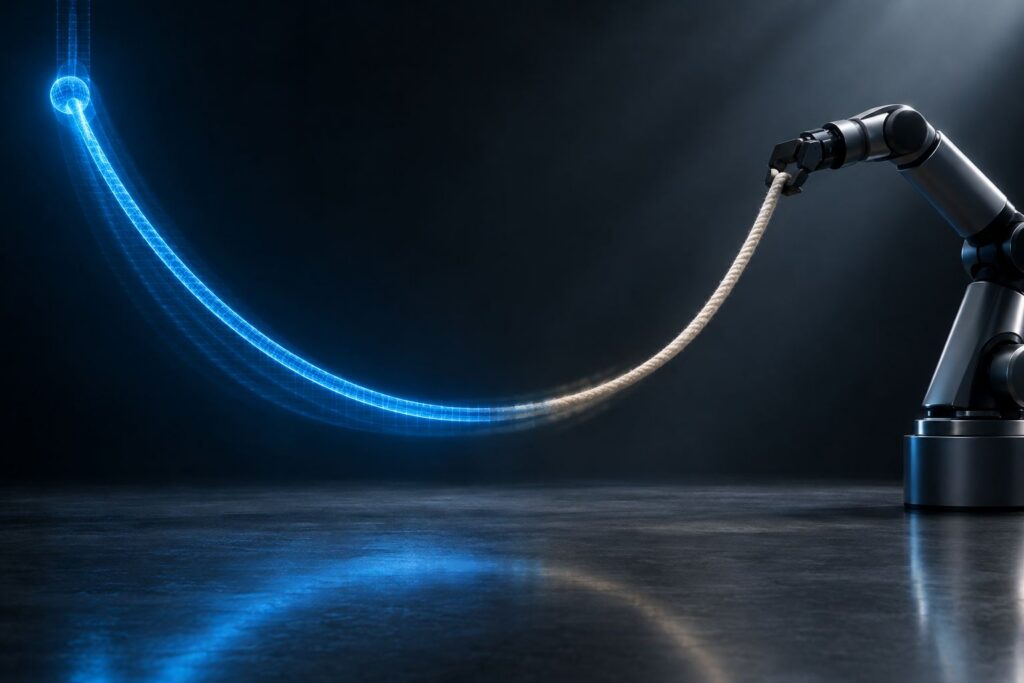
A rope controller trained almost entirely against its own physics model shows how far simulation can carry a skill, and where measured reality has to take over.
Most robot demonstrations you see involve objects that stay where they are put. A box sits still. A rope does not. Let go of one end and the thing keeps swinging long after the arm has stopped moving, so the robot’s next decision depends on physics that are still unfolding. Cables, hoses, wire harnesses and surgical thread all behave this way, and they sit in the middle of a great deal of the work people actually want machines to take over.
When The Equations Do The Teaching
A recent preprint called Self-supervised Physics-Informed Manipulation is aimed squarely at that problem, and the method it introduces goes by SPiD. The researchers took a simple mass-spring model of a rope, extended it so it tracks the swinging behaviour more faithfully while staying cheap enough to run over and over at high throughput, and then trained a neural controller directly against that model instead of against recorded human demonstrations.
They add a self-correcting step that detects when conditions during deployment have drifted away from what the controller was trained on and repairs the controller offline, with no expert supervising it. The main task is rope stabilization: a swinging rope has to be brought to rest as quickly and as smoothly as the arm can manage.
The authors report that the resulting controller settles ropes it has never encountered, across different lengths, different masses, uneven weight distributions and outside disturbances, both in simulation and on real hardware. They also report that it keeps performing when the state of the rope is read by an inexpensive markerless camera method that delivers noisy and infrequent updates, and that the same framework extends to following a target rope trajectory. For anyone building or backing robots, the practical reading is that when an object’s behaviour can be written down as equations you trust, a fast simulator can stand in for a large pile of human demonstrations.
I find the perception half more interesting than the control half. A controller that degrades gracefully when the camera is cheap and slow is a controller someone can afford to deploy, and affordability is what decides whether a laboratory result ever reaches a factory floor. I would watch the self-correction trigger closely, because detecting that you have wandered outside your training conditions is a harder and more general problem than fixing it once you know. What I would treat carefully is the jump from “this works on a rope” to “this works on deformable objects”, since a rope is close to the friendliest member of that family.
Where The Equations Run Out
A rope is one of the few everyday objects with compact, well-behaved physics. Cloth that folds onto itself, food that crushes, packaging that creases, a cable bundle wedged behind a machine, a shelf of mixed goods that shifts when you touch one item: none of these reduce to a lightweight model you can roll out thousands of times and still believe. The self-supervised shortcut works precisely to the degree that the simulator is right, and the only way to establish that it is right is to compare what the model predicted against what the physical object did. That comparison is not free. It is measurement, captured in the real world, recorded in a form that somebody can check.
Producing records like that at volume is an operating problem before it is a research one, because it takes trained, managed, quality-controlled human capacity that holds to the same standard from one shift to the next. We have that capacity through our completed acquisition of Flipside Digital Content Company, our Philippines-based operating subsidiary.1 The field’s wider difficulty is that every new material, every new container and every new workspace resets the question of whether the model still matches the object.
What Rope Teaches About The Rest
The honest lesson from this line of work is a division of labour. Physics carries the load wherever the physics is genuinely known and cheap to compute, and measurement carries it everywhere else, which is almost everywhere a robot has to go. A warehouse, a kitchen or a hospital corridor contains hundreds of objects whose behaviour nobody has reduced to equations, and the only description of them that exists is the one somebody goes out and records.
I think results like this one are easy to misread as evidence that robots are about to stop needing data. What they actually show is that data and physics models trade off against each other, and that the trade tips toward the model only in the narrow places where the world is already understood well enough to write down. Ground truth remains the scarce thing, and the list of tasks where collecting it can be skipped is shorter than it looks.
Sources
- Flipside AI: A Transformational Acquisition, 8-K, filed 2026-08-17
Disclosure
The following cautionary statement is reproduced from a Quarterly Report on Form 10-Q filed with the SEC.
Certain information included in this Quarterly Report on Form 10-Q and other filings of the Registrant under the Securities Act of 1933, as amended (the “Securities Act”), and the Securities Exchange Act of 1934, as amended (the “Exchange Act”), as well as information communicated orally or in writing between the dates of such filings, contains or may contain “forward-looking statements” within the meaning of Section 27A of the Securities Act and Section 21E of the Exchange Act. Forward-looking statements in this Quarterly Report on Form 10-Q, including without limitation, statements related to our plans, strategies, objectives, expectations, intentions and adequacy of resources, are made pursuant to the safe harbor provisions of the Private Securities Litigation Reform Act of 1995. Such statements are subject to certain risks, trends and uncertainties that could cause actual results to differ materially from expected results. Among these risks, trends and uncertainties are the availability of working capital to fund our operations, the competitive market in which we operate, the efficient and uninterrupted operation of our computer and communications systems, our ability to generate a profit and execute our business plan, the retention of key personnel, our ability to protect and defend our intellectual property, the effects of governmental regulation, and other risks identified in the Registrant’s filings with the Securities and Exchange Commission from time to time.